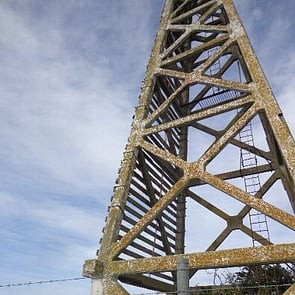
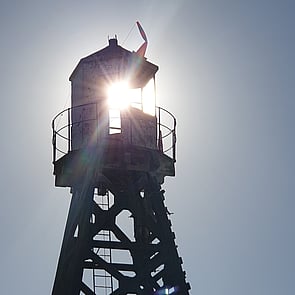
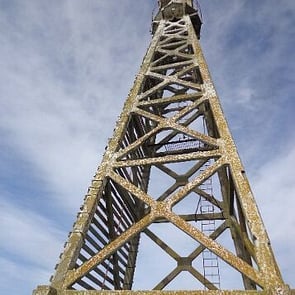
The Beacons
The Beacons made a significant contribution to the economy and growth of early Hawke's Bay by safely guiding ships into Napier's inner harbour to pick up agricultural goods for our growing export market.
The land surrounding the Beacons is historically, culturally, and archaeologically significant. The area, known as Keteketerau, is of historical significance to the local iwi. It was where they gathered kaimoana - patiki or flounder were found in abundance in the estuary.
When James Cook sailed into Hawke's Bay in October 1769, the entrance to the inner harbour lagoon, Te Whanganui-a-Orotū, was at Keteketerau. James Cook referred to Te Whanganui-a-Orotū as a "pretty lake of saltwater".
Those developing the aerodrome recognised (and still recognise) their significance and named the airport ‘The Beacons Aerodrome’ in 1.
The land was gazetted for the beacons in 1905 and the build was completed in 1907.
The Beacons were erected in 1906-07 by the Ferro Concrete Co., one on the seashore and the rear on an island in the inner harbour.
They were the first light towers in New Zealand to be constructed in reinforced concrete and the first of their kind to be constructed anywhere in the world. They were owned and operated by the then Napier Harbour Board
When the land came up in the 1931 earthquake and the rear taller Beacon was on a lean and had to be jacked back upright.
They were decommissioned in 1975.The lights can no longer be used
There was an outcry in the 1970s when is was suggested that the Beacons be used by the armed forces for meolition practice - fortunately the plans were called off when they realised the demolition had not been gazetted and the Beacons were saved.
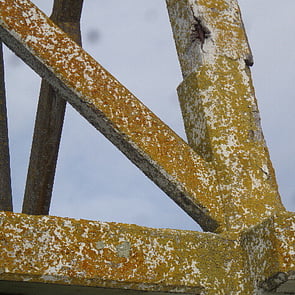
The Beacons have been neglected
Beacons are iconic landmarks, familiar to thousands travelling along State Highway 2 and enjoying local walking paths and cycleways. For generations, they have welcomed and bid farewell to visitors entering and leaving our district. Unfortunately, current neglected state sends a poor message about our care for historic assets and our community. With some repair work, we can restore their former glory so they can stand as proud symbols of our past again.